Features / Integration Catalog
Integration Catalog
An integration catalog is a central registry of all data flows between applications in your organization — who sends what to whom, through which protocol, and via which middleware. Without it, integration knowledge lives in people's heads and disappears when they leave.
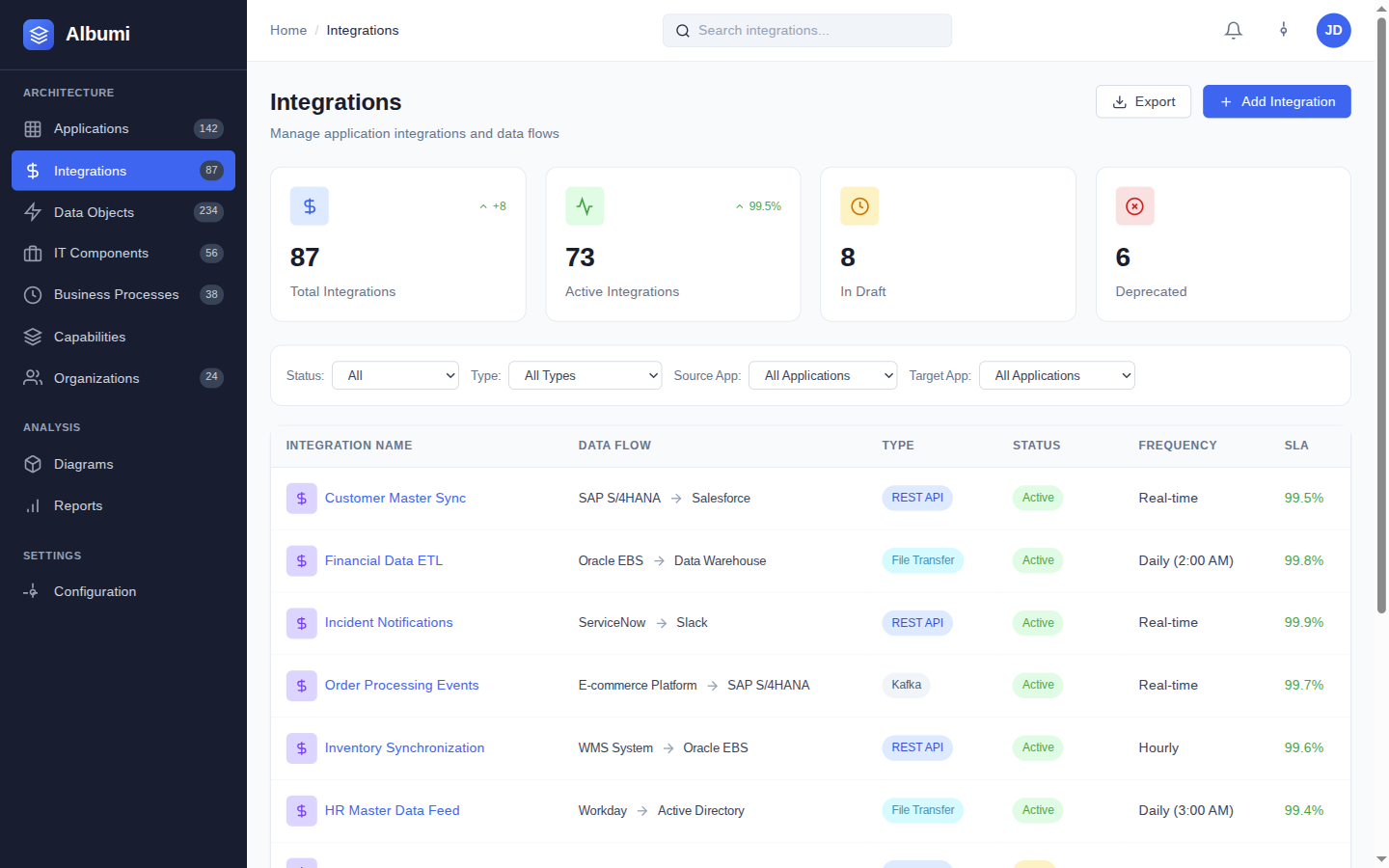
Albumi gives you a structured catalog where every integration is documented with its source and target applications, protocol, data format, middleware components, and lifecycle status. One place to answer "how do these two systems talk to each other?"
What You Can Do
Source & Target Mapping
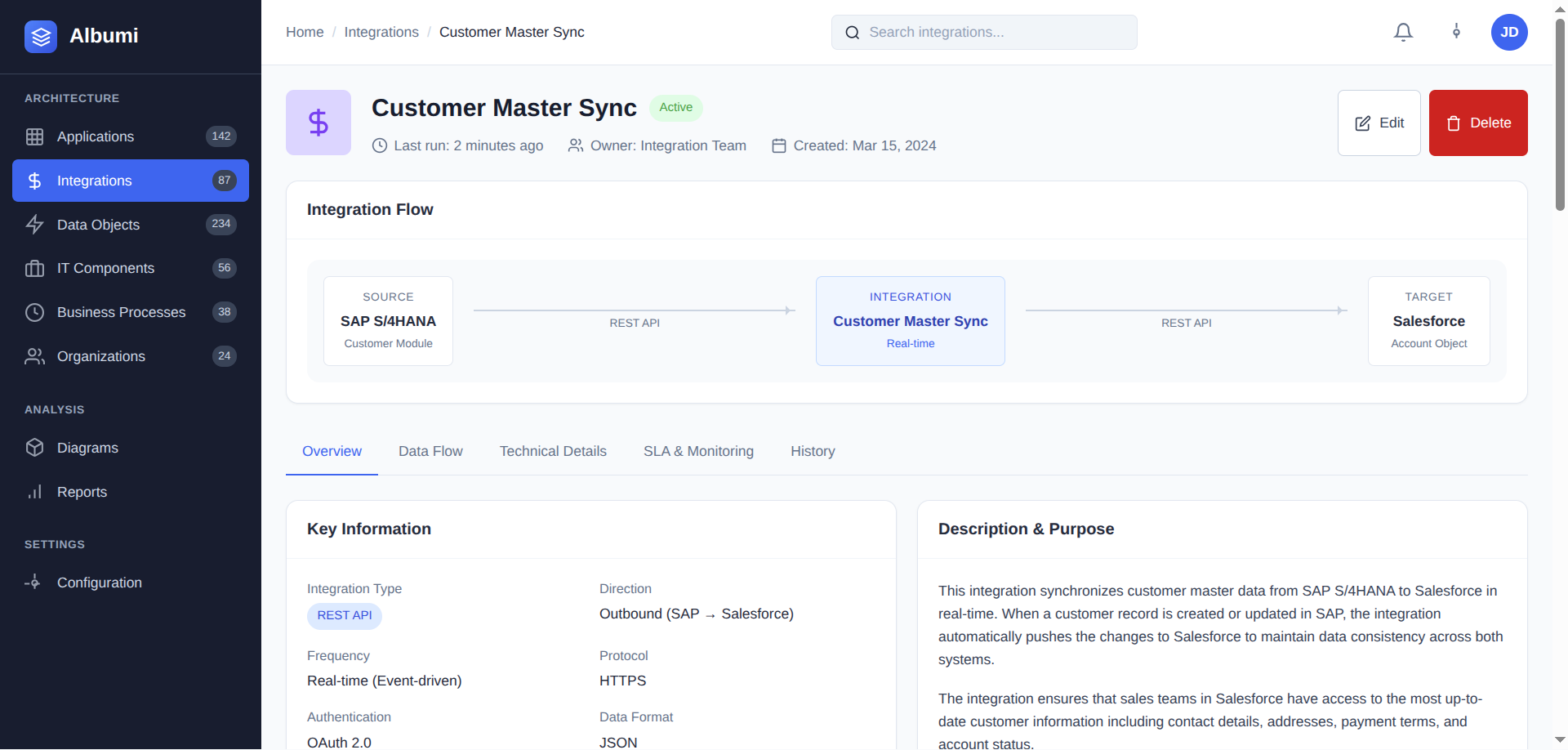
Every integration has a clear source and target application. See all outgoing integrations from any system, or all incoming data flows into it. No more guessing which systems are connected.
Protocol & Format Tracking
Track the technical details that matter — REST, SOAP, file transfer, message queue. Know the data format (JSON, XML, CSV) and frequency (real-time, batch, on-demand) for every integration.
Middleware Components
Integrations don't just go from A to B — they go through middleware. Track which integration platform, ESB, or iPaaS handles each integration so you know the full path.
Lifecycle Management
Track each integration through Plan, Phase-In, Active, Phase-Out, End-of-Life. Know which integrations are being built, which are stable, and which need to be migrated.
Data Object Linking
Link integrations to the data objects they carry — Customer, Order, Invoice. This feeds directly into data lineage, showing you exactly how sensitive data moves between systems.
Example: Auditing Your Integration Landscape
Your company has grown through acquisitions and now runs 80+ applications with hundreds of integrations between them. Nobody has a complete picture. In Albumi, you catalog each integration with its source, target, protocol, and middleware. Now you can answer: "How many integrations go through our legacy ESB?" (23), "Which integrations still use file transfer?" (11), and "What happens if we decommission the old ERP?" (14 integrations need to be migrated).
What used to require weeks of interviews with integration developers is now a filtered view in your catalog.
Map Every Integration in Your Organization
Sign up for early access and bring order to your integration landscape.
Get Early Access