
Application portfolio.
Catalog every business application with lifecycle, criticality, ownership, and disposition - and let analytics on portfolio health compute themselves from the model.
Every enterprise runs more applications than anyone can keep in their head - sometimes hundreds, sometimes thousands. CMDBs capture the technical side, spreadsheets capture fragments of the business side, and the portfolio that drives quarterly investment, retirement, and rationalization decisions gets rebuilt from interviews every time leadership needs a clear answer.
Albumi puts both halves in one place. Every application carries the planning metadata leadership actually uses - lifecycle, TIME, criticality, hosting, owner - plus the integrations, data, capabilities, and IT components that show what the application actually does. Architecture Health and Capability coverage compute on top of the same live model.
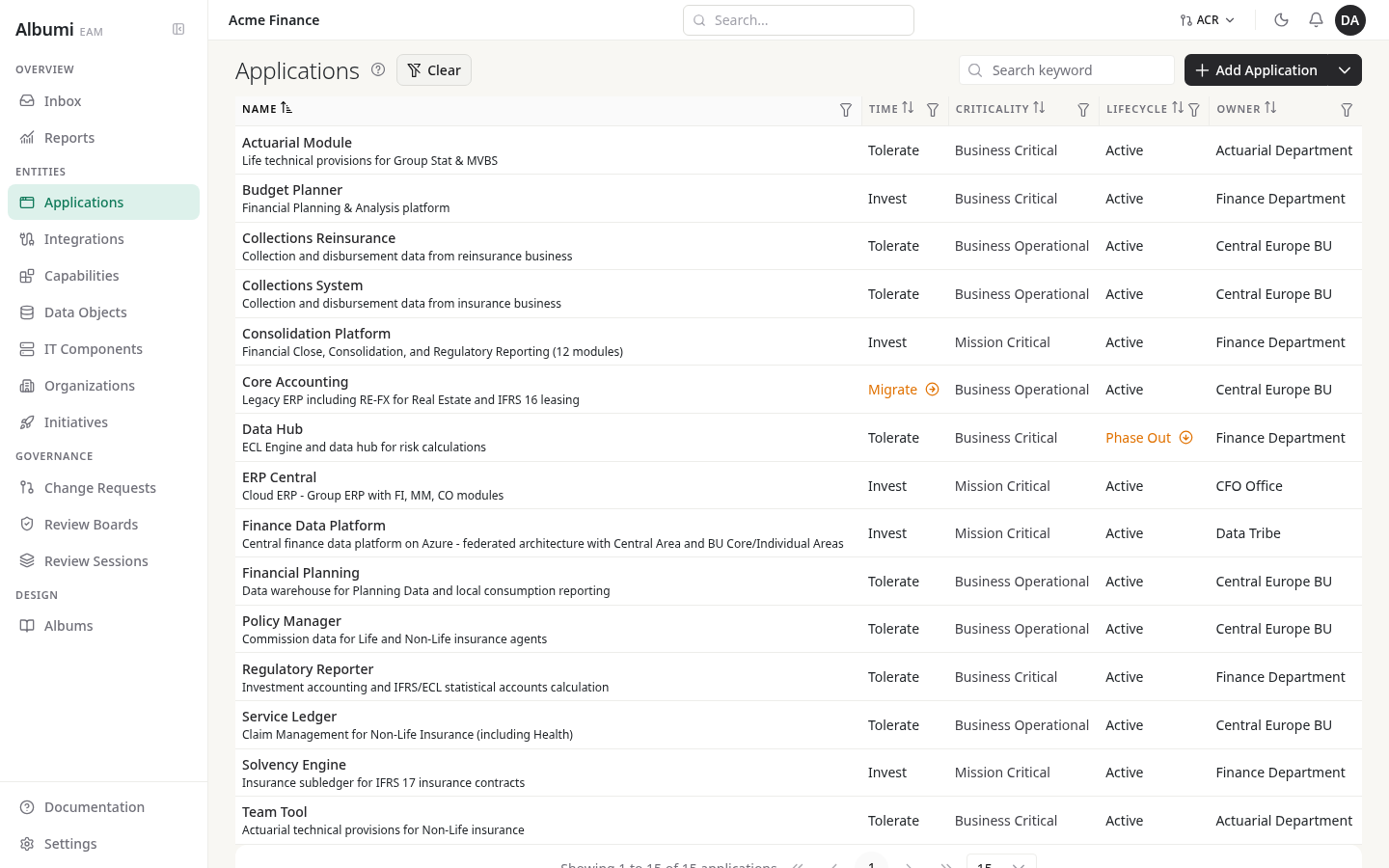
What you track in the portfolio.
Portfolio metadata that matters
Lifecycle, TIME, criticality, hosting, owner, fit assessment, and target dates all live on the application itself and stay filterable. Questions like "which mission-critical on-prem apps are in Phase-Out without a target date?" become one query.
Context around every application
Applications stay linked to integrations, data objects, capabilities, IT components, and initiatives, so the portfolio never loses operational context. Open one app and see what it sources, receives, supports, and depends on.
Strategic disposition with TIME
Tolerate, Invest, Migrate, and Eliminate turn the catalog into a planning view leadership can actually use during quarterly decisions. Combined with criticality, TIME stops the portfolio from being just inventory.
Architecture Health reporting
The workspace computes a six-dimensional health scorecard from the same live model: rationalization, integration, information governance, technology currency, catalog trustworthiness, and business alignment.
Capability coverage from the same model
Application-to-capability links produce coverage status like Gap, SPOF, Healthy, and Over-Invested, so portfolio planning stays tied to business outcomes instead of a separate deck.
Initiatives tied to real portfolio change
Applications can be grouped under migration, modernization, or consolidation initiatives, and progress can be tracked through the actual ACRs moving through governance.
Questions teams answer with it.
Which apps are drifting toward EOL?
Filter for Phase-Out systems without target dates and catch the migration problem before it turns into emergency planning. You want this conversation before the postmortem, not after it.
Where does the investment go?
Roll TIME across the full portfolio and see how many applications are being protected, modernized, migrated, or retired. This is the view finance and leadership actually sign off on.
What stack risk is buried in the estate?
Because applications stay linked to components, end-of-support databases, frameworks, and runtimes can be traced back to business systems fast. When a platform hits end-of-support, the business impact is one query away.
Who owns the messy part of the landscape?
Filter by organization or owner and turn orphaned applications, overloaded teams, and ownership gaps into concrete follow-up work instead of vague operational complaints.
Where are we over-invested or under-covered?
Use capability coverage to see where multiple applications pile onto the same function and where critical capabilities still depend on too little support.
Which programs are actually moving?
Initiative progress is grounded in approved change, not in a status meeting. Portfolio planning and governance stay tied together instead of drifting apart.
Portfolio details.
What metadata does an application carry in Albumi?
Lifecycle stage (Plan / Phase-In / Active / Phase-Out / End-of-Life), TIME classification (Tolerate / Invest / Migrate / Eliminate), business criticality (Mission Critical / Business Operational / Administrative), application type, hosting environment, owning organisation, fit assessment, lifecycle target dates, plus the integrations, data objects, business capabilities, IT components, and initiatives the application connects to.
What's the difference between Lifecycle and TIME?
Lifecycle is the operational state of the application - is it being built, running, or being retired. TIME is the strategic disposition - what's the plan. An application can be Active in lifecycle and Eliminate in TIME (running today, planned to retire); or Plan in lifecycle and Invest in TIME (being built, strategic). Two independent dimensions, both required for portfolio planning.
What are the six dimensions of the Architecture Health Report?
Application Rationalisation (25% weight), Integration Architecture (20%), Information Governance (20%), Technology Currency (15%), Catalog Trustworthiness (10%), Business Alignment (10%). Each dimension breaks down into concrete KPIs (e.g. Active applications %, Applications without TIME debt, Phase-Out apps with target date). The weighted score is the headline; the KPIs tell you what to fix.
Can applications be filtered by hosting environment or owner?
Yes. The portfolio list view supports filters on hosting (cloud / on-prem / hybrid), owner organisation, lifecycle stage, criticality, TIME, application type, and fit assessment. Filters compose, so you can answer questions like «which mission-critical on-prem applications are in Phase-Out without a target date» in one query.
How is application criticality used elsewhere in the model?
Criticality surfaces on every page that references the application - dependency views, integration tables, capability coverage badges, and Architecture Change Request impact analysis. Reviewers see at a glance what's at stake before approving a change, and capability coverage analysis treats Mission Critical applications differently when computing SPOF (single-point-of-failure) status.
Build the portfolio people actually plan against.
Build the portfolio that drives quarterly planning, rationalization, and modernization - not the spreadsheet you update once and never trust again.