
Business capability mapping.
Model what the business actually does, link those capabilities to the applications behind them, and let coverage analysis show you where to invest, where to consolidate, and where there's a gap.
Boards, finance, and product leadership do not think in applications. They think in capabilities: customer onboarding, quote-to-cash, claims handling, product delivery, risk management. Questions like "where are we falling behind?" and "which capabilities deserve the next investment dollar?" are capability questions first, IT inventory questions second.
Albumi models those capabilities directly, links them to the supporting systems, and computes coverage so the map becomes a planning tool instead of another deck artifact. It is the bridge between technical inventory and the language leadership actually uses to decide where to invest.
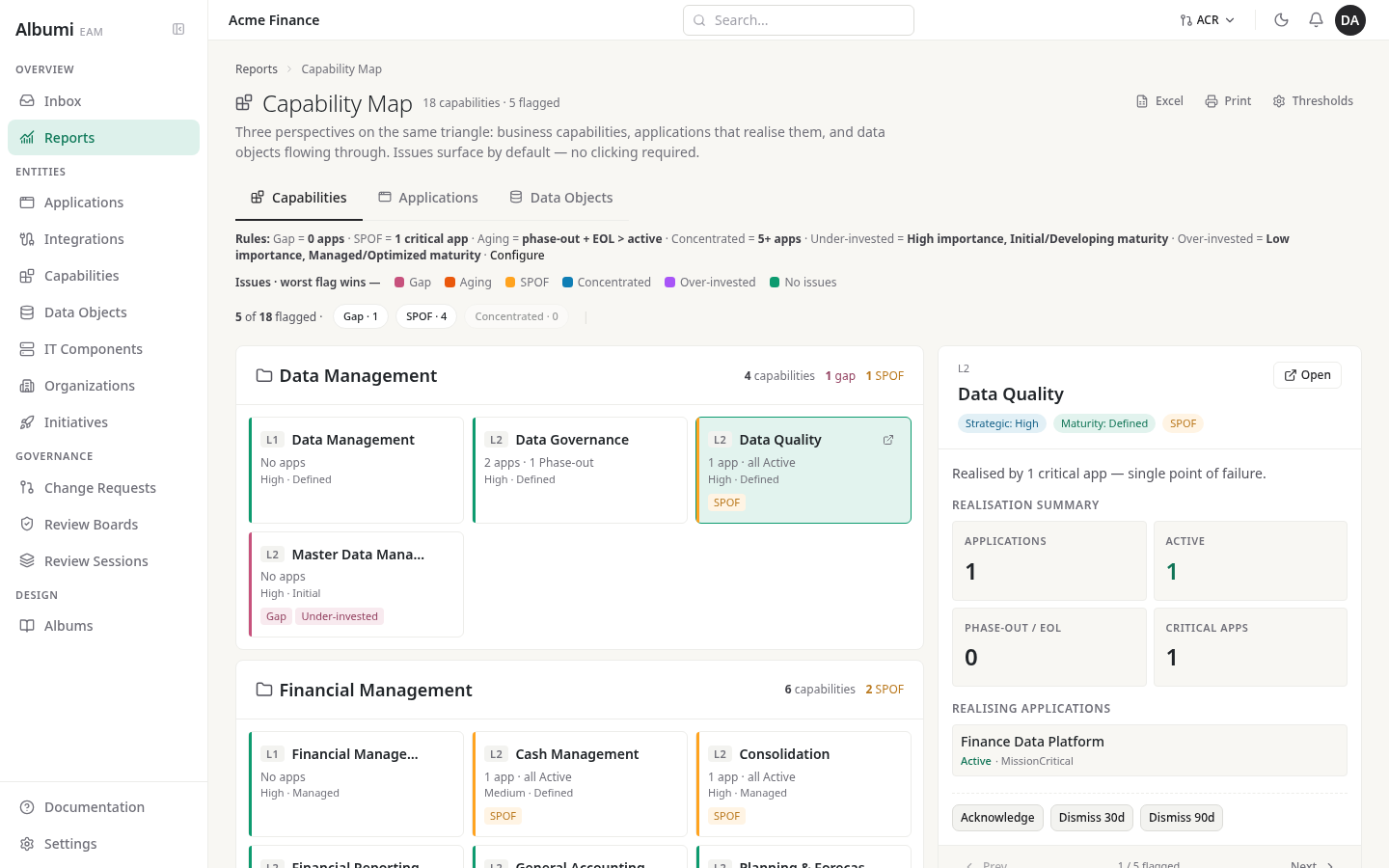
How capability mapping works.
Multi-level hierarchy
Start with top-level capabilities and break them down one or two layers until the map is useful without collapsing into process detail. Deeper than that, you are usually modeling processes instead of capabilities.
Your model, not a forced framework
Use APQC, BIAN, or another reference if helpful, but keep the structure flexible enough to match how your business actually works. Most teams end up with a custom hierarchy.
Many-to-many mapping
Applications can support multiple capabilities and capabilities can be supported by multiple applications without awkward one-to-one modeling. That mapping is what turns IT inventory into a business conversation.
Automatic coverage status
Gap, SPOF, Healthy, and Over-Invested are computed from the linked applications and their criticality instead of being judged by feel.
Strategic importance
Importance lets the same coverage signal mean different things: a gap in a core capability is a crisis, while over-investment in a low-priority one is a consolidation opportunity.
Connected landscape view
Each capability stays linked to the applications, integrations, and data behind it, so the map is navigable instead of decorative. Open a capability and see the systems underneath it immediately.
What it changes in practice.
Board conversations start with data
When leadership asks whether a strategic push is actually supported, you can open the capability, see what exists, what is missing, and which systems carry the load underneath it.
Rationalization by capability
When too many applications support the same function, duplication becomes visible enough to turn into an actionable consolidation decision instead of a vague suspicion.
Business question to IT answer fast
Questions like "what systems are involved in quote-to-cash?" stop requiring a research project because the capability already holds the links to systems, owners, and integration context.
A shared language between business and IT
The capability map becomes the layer both sides can use without translating between strategy decks and technical inventories. It stays current because it is tied to the live workspace, not a quarterly slide refresh.
Capability map details.
What is business capability mapping?
A business capability map is a structured model of what your organization does - Sales, Customer Onboarding, Risk Management - independent of how it's currently implemented. By linking each capability to the applications, integrations, and data that support it, the map becomes a bridge between IT inventory and strategic conversations about investment, gaps, and consolidation.
Do I have to use a reference framework like APQC or BIAN?
No. Albumi treats your capability hierarchy as your model - APQC and BIAN are useful starting points but not gospel. Most organizations end up with a custom hierarchy that fits their industry and structure. You can always re-align with a reference later.
Can one application support multiple capabilities?
Yes. The application-to-capability relationship is many-to-many. A CRM can support "Lead Management", "Opportunity Tracking", and "Customer Communication" simultaneously. The model captures that without forcing one-to-one mappings.
How deep should a capability hierarchy be?
Most working maps are two or three levels deep. Top-level capabilities (Sales, Operations, Finance) decompose into sub-capabilities, which can decompose once more if useful. Deeper than three levels usually means you're modeling processes, not capabilities.
What does each coverage status mean?
Gap - no application supports this capability (the business says it's important; IT isn't delivering). SPOF - a single mission-critical application supports it (single point of failure). Healthy - adequate coverage with two or three applications sharing the load. Over-Invested - too many applications on the same capability (consolidation opportunity).
Link strategy to the systems underneath it.
Build your capability map and connect it to the applications that matter.