
Architecture governance and initiatives.
Review every proposed change to the model, route it to the right board, vote on it, and keep an audit trail of who approved what - without leaving the workspace.
In any real enterprise, architecture decisions do not happen in isolation. New applications get bought, old ones get retired, integrations are added, data objects move around, and every such change touches multiple teams, multiple capabilities, and multiple compliance boundaries. Without a structured way to propose, review, and record those changes, teams move independently, technical debt accumulates invisibly, and nobody knows who approved what.
Albumi keeps the proposal, the review path, and the live model in one workspace. The change request is the proposal, the model is the source of truth, and the merge is the act of governance. Review Boards, Sessions, and Initiatives all sit on top of the same architecture data.
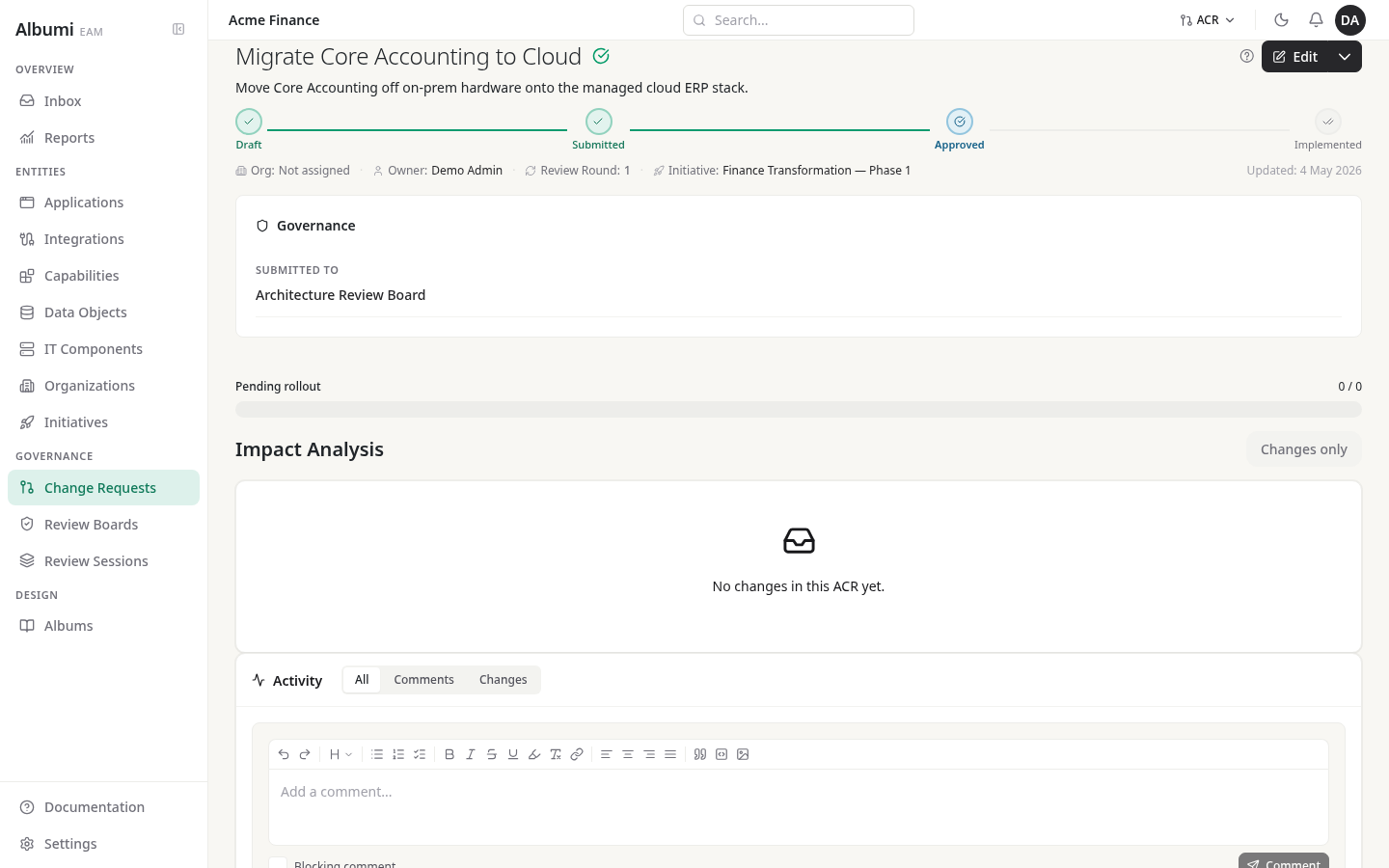
How governance runs in Albumi.
Architecture Change Requests
An ACR is the proposed package of additions, modifications, and removals. Nothing touches the live workspace until the assigned board approves the request.
Review Boards with explicit membership
Architecture, Security, Data Governance, or any board you need can be modeled with voting members, advisory members, and a chair. Routing stays explicit instead of being forced by hard-coded entity rules.
Review Sessions
Sessions hold the agenda, participants, and recorded votes so meeting context does not disappear into calendar history. Status flows Draft to Scheduled to In Progress to Completed.
Strategic Initiatives
Large migrations and programs can be scoped as initiatives and tracked through the ACRs that actually move the work forward, with Add, Modify, and Remove actions per scoped item.
Automatic audit trail
State changes, comments, votes, and approvals stay queryable in the workspace instead of being scattered across tools. "Show me every ACR approved by the Security Board in Q2" becomes a workspace query.
Same path for AI-generated change
AI-proposed changes land as ACRs too, so automation does not create a parallel shortcut around the same governance humans follow.
What changes operationally.
Decision traceability without exports
Who proposed the change, who voted, when it changed state, what was said in comments, and which session recorded the decision all stay attached to the request.
Program tracking from real workflow data
Initiative coverage is computed from actual approved work, not from status reports that drift from the model. Program dashboards reflect workspace truth instead of a manual tracker someone updated last week.
Same path for humans and AI
AI-generated changes land as ACRs too, so governance stays consistent instead of creating a parallel shortcut for automation.
No shadow governance tool
The proposal, the review, and the resulting model stay in one place. You do not need a separate spreadsheet, ticket flow, or export step just to explain how change was approved.
Governance details.
What is an Architecture Change Request (ACR)?
An ACR is a structured package of additions, modifications, and removals to your workspace - proposed but not yet merged. Architects, project leads, or AI agents create ACRs; the proposal sits separately from the production model until the assigned Review Board votes Approve. Until then, none of the proposed changes touch the live workspace.
What is a Review Board?
A Review Board is a configurable group with explicit voting and advisory members - Architecture Review, Security, Data Governance, or whatever boards your organization needs. Each board has a chair, voting members, and advisory members. ACRs are reviewed during Sessions; the board votes per-ACR with rationale recorded.
Does Albumi auto-route ACRs to boards by entity type?
No. Routing is chosen by the ACR author or your workflow, not assigned automatically. This is intentional - every organization splits decision rights differently, and a hard-coded routing rule would force a structure most teams don't actually use. Explicit routing reflects how your organization already works.
How does initiative tracking work?
An Initiative is a program - a system migration, a capability rollout, a vendor consolidation. You scope it by listing affected applications, integrations, capabilities, or data objects, each with a declared action (Add, Modify, Remove). Coverage is computed from the ACRs landed against scope items, so the dashboard reflects workspace truth without a manual tracker.
Is there an audit trail?
Yes. Every ACR carries the proposer, the timestamps of every state change, every vote on every round, the comments left, and the session where each decision was recorded. The trail is queryable for compliance review without an export step.
Review change before it lands.
Run governance in the workspace that holds your model - not in a separate tracker that drifts from it.